Tech Activism

As you may of heard, there was a proposition in Austin that had an impact on ride sharing, specifically on tech companies/startups Uber and Lyft.  See this article if you are not familiar with the situation or want a refresher.

A lot of people in the tech community are upset about this decision, as they feel Austin is being anti-tech/startup.

The part that is disappointing is that people are being very vocal about this proposition AFTER the vote has already taken place.  One thing I have witnessed in living in the Bay Area and NYC, is that the startup community, broadly speaking, aren’t very involved in local politics.

If you look at the results of the proposition, it shows you that a very small percentage of the population ultimately made the decision.

Austin has a population of almost 900K people and as you can see below, 10K people were the difference in opposing the measure that has impacted Uber/Lyft.  The article that I reference above indicated that only 17% of REGISTERED voters participated in this specific proposition.

We, being the collective tech community, need to do a much better job of not only making our voices heard but connecting with those in non-tech community to influence their decisions.  Sending out tweets isn’t enough, their needs to be people in the street communicating the message directly to local citizens and also calling/mailing/emailing the local/state/federal politicians.

I’m using this specific Austin situation as a recent example, so this isn’t meant to only call them out.  Similar situations have happened in other cities.


Voting Results:

6085164897140736.png

Austin Population:

5388338766282752.png

Slack’s Valuation

As you may of heard, Slack just raised a $200M round of financing at a $3.8B valuation.

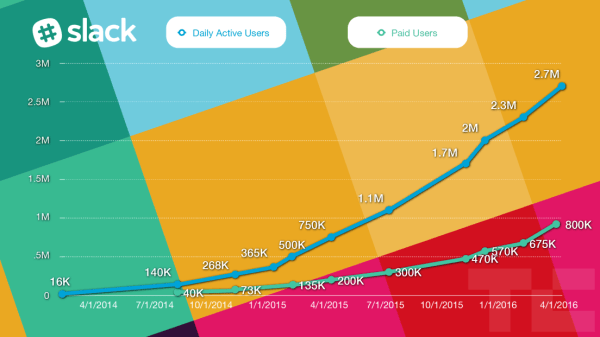
Per the first image below, they have 800K paying users.

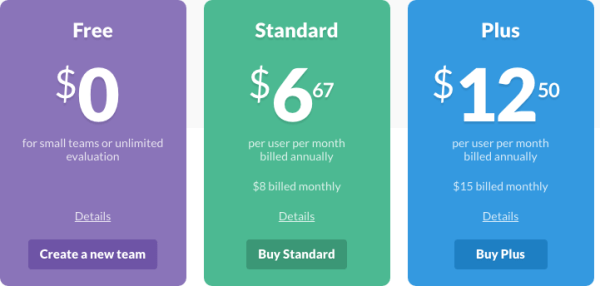
If you look further down at the second image, you can see how much they charge paying users, between $6.67 per month or $15 per month.

Assuming all their 800K paying users are at the lower tier of $6.67 per month, they are at $64M in annual recurring revenue ($6.67 x 12 months x 800K).  If they were a public company at this revenue, they would be trading at a 60x revenue multiple ($3.8B/$64M).

If their 800K paying users were at the high tier of $15 per month, they are at $144M in annual recurring revenue and 26x revenue multiple ($3.8B/$144M).

Realistically, their users are paying somewhere in the middle of $6.67 and $15, so splitting the difference of 60x and 26x multiple, they would need to trade at a 42x multiple.

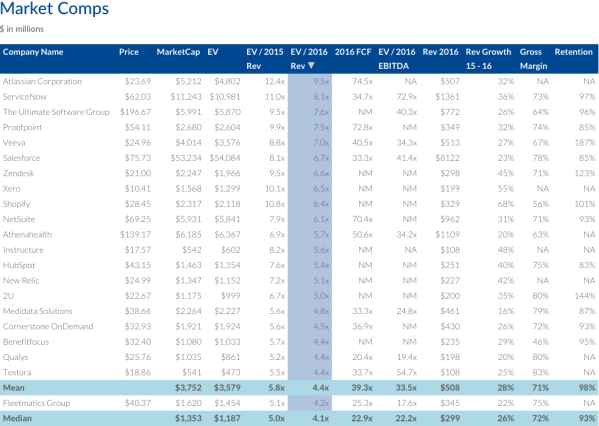
Taking a look at the Bessemer Cloud Index, you can see that the largest multiple of public saas companies is Workday, trading at a 10x revenue multiple.  So assuming the best case scenario, Slack is getting paying users at the upper tier of $15/month, the 26x revenue multiple is much bigger than Workday’s.  That being said and a major implication to their current valuation, they are growing at a much faster pace than Workday or any other company in the Cloud Index.

If you look at the valuation of companies in the Cloud Index, fourth image below, only 9 companies have a higher valuation than Slack’s $3.8B.

Given Slack’s revenue and growth rate, they could IPO today, but the big question is what their market capitalization could be.

slack-users-paid-seats-chart604669837416857657353263985459206005899137646592

$FB vs $TWTR vs Snapchat

When these companies were at a similar life stage, (ie going from ~$100M to ~$300M in revenue) they had very different private market valuations.

Snapchat = $16B
Facebook = $10B
Twitter = $8B

The question for me is whether one is over-valued or were the other two under-valued?

Here are some tweets below with links to the data.


2016, an opportunity for VCs

2016 is off to a very rocky start.  I don’t know if we are headed into the recession but the private market will be impacted with what is currently happening in Chinese stock markets, oil prices and US stock markets.

I expect 2016 to be similar to 2009 in terms of how the private market (venture world) will be impacted.  I suspect that many VCs are going to pull back this year, mainly to focus on existing portfolio companies in order to get them another round of equity/debt financing (aka oxygen) and/or help them get to an acquisition (or soft landing).

That being said, some VCs are going to be opportunistic and make MORE investments in 2016 vs 2015.  In down markets, VCs can get more ownership in companies since valuations drop due to supply/demand dynamics.  Many VCs will tell you that in order to generate 3x+ fund returns, entry valuation price / ownership % is critical.

I utilized CB Insights to research which VCs increased their Seed/Series A investment pace in 2009 vs 2008.  The top six firms that increased their pace were Founders Fund, First Round Capital, True Ventures, Accel Partners , Venrock and Bessemer (listed by most # of early stage deals in 2009).

It will be interesting to revisit 2016 and do a similar query to see which VCs increased their pace in 2016 vs 2015.


Maple

Maple is a vertically integrated food startup in NYC.  They launched in early/mid 2015 and recently expanded their coverage area to midtown , which is where my office is.

I really liked their packaging and quality of the food (the most important part).

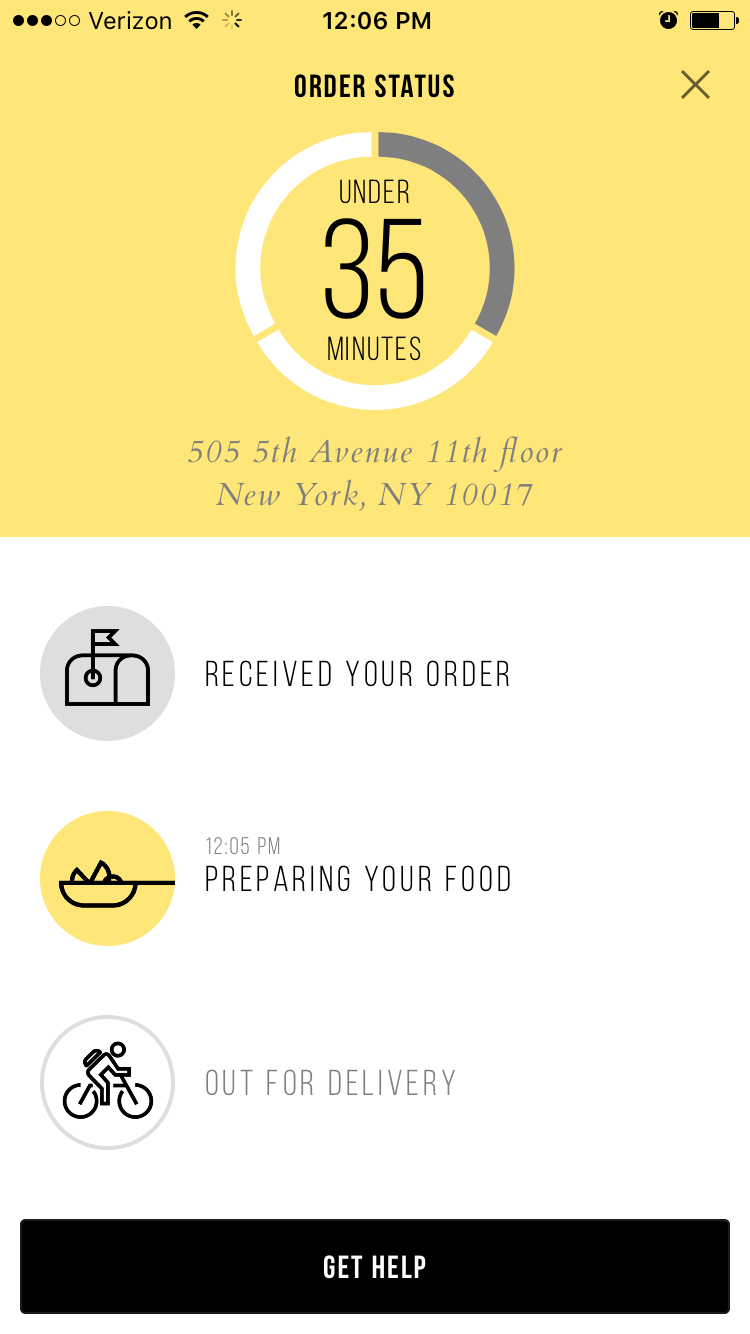
The only issue I had was their delivery time, they had indicated 35 minutes but actually took 55 minutes.

I’ve tried the UberEats service multiple times but didn’t like the packaging of the food but their delivery times were typically less than 10 minutes, so super fast if you are in a time crunch.  It is a bit of a apples and oranges comparison as Maple makes the food and UberEats is just delivering (for now).

This is a massive market which is evolving quickly.  Looking forward to trying other services out, including Sprig, which hasn’t launched in NYC yet.


2016-01-11 13.09.04

Hiring An Associate in Menlo Park

We (Silicon Valley Bank – SVB) are looking to hire an Associate/Analyst ASAP.  The position will be in Menlo Park, at our Sand Hill Road office. Relocation expenses are not included.

The individual will be working directly with the SVB team that manages our venture capital relationships nationally and our big data team.

You WILL learn the inside baseball of venture capital.

To clarify, this is NOT a VC position, so you are not making investments or sourcing investment opportunities.

You are working on projects/reports, doing analytics, supporting the team and LEARNING about the industry.

We are looking for a recent graduate with a BS/BA degree.

You need to have work experience, preferably in an area that is related to the position but that is not mandatory.

You have to be a team player but also have the ability to work on your own.   Great communication skills are imperative.

You have to be passionate about venture capital and startups, that is the MAIN requirement.  If you can clearly demonstrate your passion about the space via a cover letter, we will give your resume a hard look.

We expect the individual who is hired to stay within their position for two years.

If you are very excited about the opportunity to work at SVB and learn, please email me at sgoldman@svb.com .  Subject line: Associate Position.

By the end of July, will respond to candidates who fit the above description/requirements.

Private Market Bubble

Semil Shah sent out this tweet with this image below that was put together by Tomasz Tunguz.  There are a few things causing this meteoritic rise of growth rounds from my perspective.

  1. There is a lot (and too much) private capital available for startups (private companies) right now.  This creates an opportunity to raise large rounds.
  2. Due to cross-over investors participating in the private markets, some of these startups don’t have to go public to raise money.  IPOs are partially used to create liquidity for investors (and employees) who participated in private rounds.  Many of these large rounds are now providing the same liquidity that IPOs used to create.
  3. Some might argue that the public markets are partly broken, which is driving the large market rounds.  Not sure I agree with this perspective though.

CBr-mPXUIAEYZBe

2015: NYC En Fuego

The start of 2015 has been amazing in NYC, when you look at the velocity of VC funding activity.  I haven’t done a full analysis, but this is likely the most active month EVER in terms of big VC rounds being announced.  The impressive thing is the diversity in terms of sub-sectors being represented (some people still think this is a adtech & content town only).  I understand that VC financings is not the end game, but money does help in growing your company and getting to an exit.  Here is a list of $10M+ VC rounds that were announced in January 2015 (used CBInsights to get the data).

  1. Business Insider – $25M
  2. Datadog – $31M
  3. Giphy – $17M
  4. Mashable – $17M
  5. Earnest – $17M
  6. Button – $12M
  7. Persado – $21M
  8. Work Market – $20M
  9. Stack Exchange – $40M
  10. Taykey – $15M
  11. ClassPass – $40M
  12. Schweiger – $12M
  13. IRX Therapeutics – $32M
  14. Boxed – $25M
  15. Whistle – $28M
  16. Defense Mobile – $20M
  17. MongoDB – $80M
  18. Noom – $15M
  19. Reonomy – $13M

VC Funds Below $200M In Size

I have been actively tracking VC funds at/below $200M in size.  I am constantly asked for help from Founders who are trying to raise capital, so I created this resource.  This list is especially valuable as it gives Founders a sense of who has capital to invest, by looking at the when the fund was raised.  Typically if a VC’s fund is less than three years years old, they have some “dry power” to make new investments. If you have any firms that should be added, please send me a tweet to @shaig with the details.

Link:

https://docs.google.com/spreadsheet/ccc?key=0Ar2jKST-_k4GdGlaRFltQlZVWDlNUkZ6VldoVzVicGc#gid=0

Thoughts on OnDeck Capital IPO

New York City based OnDeck Capital filed for their IPO.

This is how they describe themselves “OnDeck powers the growth of small business through lending and technology innovation”.

I’m excited about this upcoming IPO for several reasons.  First, this is going to be a positive event for the NYC tech scene, including several NYC based VCs who invested early and many of the employees (216 based in NYC per LinkedIn). Secondly, I’ve been in the financial services sector for over 15 years and haven’t seen many financial related IPOs, so that is nice to see and it is a trend.  Lastly, since the market downturn of 2008, majority of banks have lost their appetite to lend to small business, so this is a much needed product, which is one of the main drivers of their growth.

Some highlights:

  • They have choose the NYSE and will be traded under the symbol ONDK
  • Company started in 2007
  • Major investors are RRE (15.4%), IVP (14.4%), Village Ventures (10.8%), SAP Ventures (10.1%), First Round Capital (6.5%), Google Ventures (6.3%), and Tiger (6%)
  • Top line revenue has grown over 2.5x over the last year.  $107.6M (2014) vs $42M (2013).  Both figures are for 9 months.
  • They are at a $143.4M annual revenue run rate
  • Net loss has shrunk in the last year, which is great news considering revenue has grown over 2.5x.  $14.4M (2014) vs $18.8M (2013).   Both figures are for 9 months.
  • While sales/marketing expense has gone up, it is going up at a slower rate of 1.6x compared to revenue which has grown at 2.5x:  $21.8M (2014) vs $13.6M (2013).  Both figures are for 9 months.
  • Loans originated: $788.3M (2014) vs $290.9M (2013).  Both figures are for 9 months.
  • They are originating more loans (both number and dollars) directly vs indirectly.  43% (2014) vs 19.4% (2012).  This is % of total dollar volume loans.
  • 15+ day delinquency ratio has gone down from 8.9% (2012) to 5.4% (2014).