Hiring An Associate in Menlo Park

We (Silicon Valley Bank – SVB) are looking to hire an Associate/Analyst ASAP.  The position will be in Menlo Park, at our Sand Hill Road office. Relocation expenses are not included.

The individual will be working directly with the SVB team that manages our venture capital relationships nationally and our big data team.

You WILL learn the inside baseball of venture capital.

To clarify, this is NOT a VC position, so you are not making investments or sourcing investment opportunities.

You are working on projects/reports, doing analytics, supporting the team and LEARNING about the industry.

We are looking for a recent graduate with a BS/BA degree.

You need to have work experience, preferably in an area that is related to the position but that is not mandatory.

You have to be a team player but also have the ability to work on your own.   Great communication skills are imperative.

You have to be passionate about venture capital and startups, that is the MAIN requirement.  If you can clearly demonstrate your passion about the space via a cover letter, we will give your resume a hard look.

We expect the individual who is hired to stay within their position for two years.

If you are very excited about the opportunity to work at SVB and learn, please email me at sgoldman@svb.com .  Subject line: Associate Position.

By the end of July, will respond to candidates who fit the above description/requirements.

Private Market Bubble

Semil Shah sent out this tweet with this image below that was put together by Tomasz Tunguz.  There are a few things causing this meteoritic rise of growth rounds from my perspective.

  1. There is a lot (and too much) private capital available for startups (private companies) right now.  This creates an opportunity to raise large rounds.
  2. Due to cross-over investors participating in the private markets, some of these startups don’t have to go public to raise money.  IPOs are partially used to create liquidity for investors (and employees) who participated in private rounds.  Many of these large rounds are now providing the same liquidity that IPOs used to create.
  3. Some might argue that the public markets are partly broken, which is driving the large market rounds.  Not sure I agree with this perspective though.

CBr-mPXUIAEYZBe

2015: NYC En Fuego

The start of 2015 has been amazing in NYC, when you look at the velocity of VC funding activity.  I haven’t done a full analysis, but this is likely the most active month EVER in terms of big VC rounds being announced.  The impressive thing is the diversity in terms of sub-sectors being represented (some people still think this is a adtech & content town only).  I understand that VC financings is not the end game, but money does help in growing your company and getting to an exit.  Here is a list of $10M+ VC rounds that were announced in January 2015 (used CBInsights to get the data).

  1. Business Insider – $25M
  2. Datadog – $31M
  3. Giphy – $17M
  4. Mashable – $17M
  5. Earnest – $17M
  6. Button – $12M
  7. Persado – $21M
  8. Work Market – $20M
  9. Stack Exchange – $40M
  10. Taykey – $15M
  11. ClassPass – $40M
  12. Schweiger – $12M
  13. IRX Therapeutics – $32M
  14. Boxed – $25M
  15. Whistle – $28M
  16. Defense Mobile – $20M
  17. MongoDB – $80M
  18. Noom – $15M
  19. Reonomy – $13M

VC Funds Below $200M In Size

I have been actively tracking VC funds at/below $200M in size.  I am constantly asked for help from Founders who are trying to raise capital, so I created this resource.  This list is especially valuable as it gives Founders a sense of who has capital to invest, by looking at the when the fund was raised.  Typically if a VC’s fund is less than three years years old, they have some “dry power” to make new investments. If you have any firms that should be added, please send me a tweet to @shaig with the details.

Link:

https://docs.google.com/spreadsheet/ccc?key=0Ar2jKST-_k4GdGlaRFltQlZVWDlNUkZ6VldoVzVicGc#gid=0

Thoughts on OnDeck Capital IPO

New York City based OnDeck Capital filed for their IPO.

This is how they describe themselves “OnDeck powers the growth of small business through lending and technology innovation”.

I’m excited about this upcoming IPO for several reasons.  First, this is going to be a positive event for the NYC tech scene, including several NYC based VCs who invested early and many of the employees (216 based in NYC per LinkedIn). Secondly, I’ve been in the financial services sector for over 15 years and haven’t seen many financial related IPOs, so that is nice to see and it is a trend.  Lastly, since the market downturn of 2008, majority of banks have lost their appetite to lend to small business, so this is a much needed product, which is one of the main drivers of their growth.

Some highlights:

  • They have choose the NYSE and will be traded under the symbol ONDK
  • Company started in 2007
  • Major investors are RRE (15.4%), IVP (14.4%), Village Ventures (10.8%), SAP Ventures (10.1%), First Round Capital (6.5%), Google Ventures (6.3%), and Tiger (6%)
  • Top line revenue has grown over 2.5x over the last year.  $107.6M (2014) vs $42M (2013).  Both figures are for 9 months.
  • They are at a $143.4M annual revenue run rate
  • Net loss has shrunk in the last year, which is great news considering revenue has grown over 2.5x.  $14.4M (2014) vs $18.8M (2013).   Both figures are for 9 months.
  • While sales/marketing expense has gone up, it is going up at a slower rate of 1.6x compared to revenue which has grown at 2.5x:  $21.8M (2014) vs $13.6M (2013).  Both figures are for 9 months.
  • Loans originated: $788.3M (2014) vs $290.9M (2013).  Both figures are for 9 months.
  • They are originating more loans (both number and dollars) directly vs indirectly.  43% (2014) vs 19.4% (2012).  This is % of total dollar volume loans.
  • 15+ day delinquency ratio has gone down from 8.9% (2012) to 5.4% (2014).

Building Trust With Your Investors

As you may know, there is tension between investors and entrepreneurs in general.  There is a long history of bad blood and poor actions on both sides that I won’t get into right now.

During my time as an investor, I have found that the easiest way for an entrepreneur who has raised money from me to build trust, is to over communicate the health/status of their company.

As a very active seed investor, we typically don’t have a lot history with the founder(s) and usually invest after a few meetings, so while there is some trust built during the investment process, you still don’t really know each other that well.   So trust (on both sides) is built over time.

If you have taken money from investors, I encourage you send monthly updates to them.  I have created an easy template to follow.  The information that I ask for (and that investors want) is something that you should be tracking and sharing within your respective organizations in any case, so it is not onerous.

The side benefit to the entrepreneur to send monthly updates is that your investors/angels will bug you less often as they already know how things are going, so it allows you more time to focus on your business and less time doing coffee meetings with all your investors.

The other benefit is that when you need to raise that bridge/extension round (which is highly likely), you have built trust with your investor(s), so you have a better shot of raising that inside round.  I have seen several situations where I don’t receive any information from an entrepreneur for six months (or more) and then they come to me saying things aren’t going well, please invest more money, that is not a good situation to be in as an entrepreneur.

List of NYC equity based accelerators

NYC accelerators:

So AngelPad (a SF based accelerator) just announced at the #premoney conference that they are expanding to NYC.  There are now 15 equity based accelerators in NYC.

  1. @angelpad
  2. @techstars
  3. @DreamitVentures
  4. @ERoundtable
  5. @bphealth
  6. @SeedStart
  7. @NYeHealth
  8. @FinTechLab
  9. @WIMAccelerator
  10. @startuphealth
  11. @EdTechAccel
  12. @SocraticLabs
  13. @founding
  14. @FinTechNY
  15. @RGAaccelerator

Investor Updates – Email Template

If you have raised funding from investors, you should be providing at least quarterly updates, although I much prefer monthly updates.  Here is what I want to see from Founders:

  1. Specific metrics (revenue, number of customers, downloads, MAU, DAU, KPIs, churn %, etc)
  2. Cash position, how much do you have, what is your monthly burn and how much runway do you have left
  3. If your runway is close to 6 months, I wanted to undertand what your fundraising strategy is
  4. Product updates
  5. What is going well
  6. What is NOT going well (don’t bullshit, you need to be transparent)
  7. What do you need help with (what are the action items for your investors?)
  8. Current headcount
  9. New hires
  10. Open positions
  11. Press
  12. Other

Keep it succinct, you should be able to keep it to one page in length.

Instagram vs Indeed

I had a brief twitter chat with two active people in the NYC tech ecosystem, but wanted to further clarify my perspective in a blog post.

As a prelude, this post is not a reflection as to which company is better or which specific community is better but an example of how two separate exits can have a distinct impact on their respective tech communities.

Both Instagram and Indeed ($1.1B) were amazing exits for the Founders and early investors. That being said, the Indeed exit is much better for a tech ecosystem than the Instagram exit. Here are a few reasons why.

  1. Instagram had a total of 13 employees at the time of the exit. Per LinkedIn, Indeed has 553 employees. Indeed has created a lot more jobs.
  2. Indeed will continue to operate, grow their business and hire more people. Instagram was essentially a defensive acquisition by Facebook. I’m sure the Instagram team will continue to improve the product but I wonder how much larger the team is going to be and if they are going to be run somewhat independent than other teams at Facebook.
  3. Instagram was a no-revenue based startup with the focus on growing users and figuring out a monetization later. Indeed was built with the mind set of generating revenue in their early days and according to their investor, USV, Indeed didn’t need VC funding to grow their business. The Instagram exit propagates the idea that you can just build an application without a revenue model and become successful. Many entrepreneurs are trying to replicate an Instagram but sadly 99% will fail.
  4. Per Crunchbase, Instagram raised $57.5M, Indeed raised $5M. The Indeed acquisition provides a great example of how you can scale your business without raising a lot of money. The mindset of minimizing how much you raise is positive. VC funding is critical for many startups but raising too much money can have very negative consequences and I don’t want to see other entrepreneurs have the idea that raising a lot of money is some sort of badge of honor.
  5. To my earlier point, Indeed has a lot more employees, as a result, a lot of experienced employees will have the ability and money to start their own companies. My guess is that Indeed employees will create more startups than the Instagram employees.

As a last point that is not as relevant to which is better exit for a tech community, Indeed took nearly eight years to build, scale and sale their company.  Instagram was built,  scaled and sold in two years.  Startup Founders need to understand that building a valuable company takes a lot of time, like an Indeed and not an Instagram.

[View the story “Instagram vs Indeed” on Storify]

NYC Seed Syndicates

I wanted to understand who the most active seed investors are and which syndicates were the most prominent. For the purpose of this report, the search criteria were:

  • Startups based in NYC
  • First round of financing must have been between January 2010 and April 2012
  • Round size between $250K and $1.5M

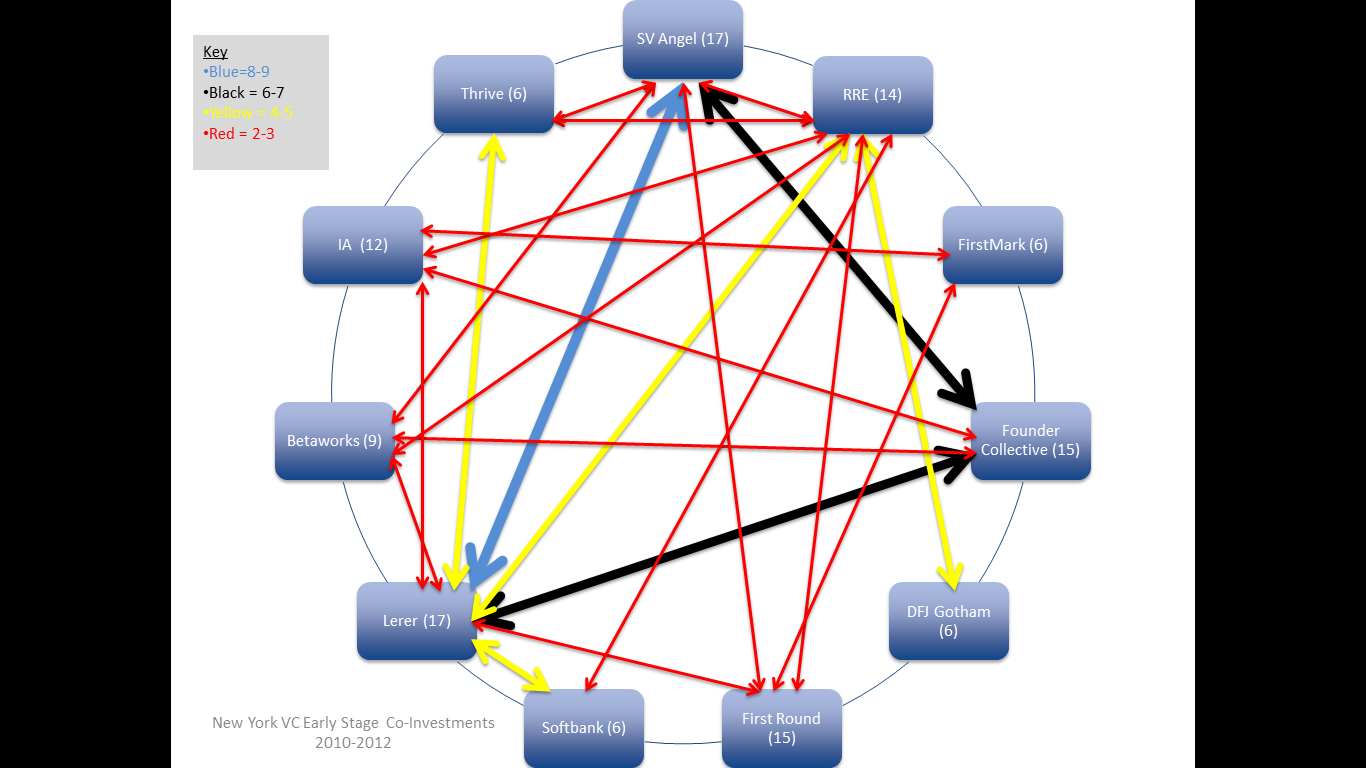
The research yielded interesting results. The most active investors over the time period were SV Angel and Lerer Ventures, each with a total of 17 investments.  The other most active firms were RRE Ventures and Founder Collective with 15 while First Round Capital had 14.

The most active investment syndicate was SV Angel & Lerer Ventures with 9 co-investments. This is not a surprise as it was mentioned in May 2011, that the two firms would work together closely. Next was SV Angel & Founder Collective with a total of 7 co-investments followed by Lerer Ventures & Thrive Capital with 5.

When you see firms syndicating frequently, it could suggest that the firms know each other well and/or have similar investment themes; As an entrepreneur raising a seed round, knowing this information can be very helpful.

The two diagrams below help to illustrate the findings. The first is a venn diagram attempting to show some of the major investment connections while the second diagram gives a more complete view of the connections between the different firms. In each diagram, the total number of investments made by that firm is in parentheses next to their names.

All of data used for the diagrams below were from sources available to the public. The vast majority of the data was sourced from CB Insights (a NYC startup).  Some of the rounds of financing are not disclosed or file State documents, so these diagrams don’t represent 100% of all financings using the criteria mentioned above.

Thank you to our Intern, Jacob Laufer, for compiling the data and putting together the diagrams.