The $240 Billion Opportunity

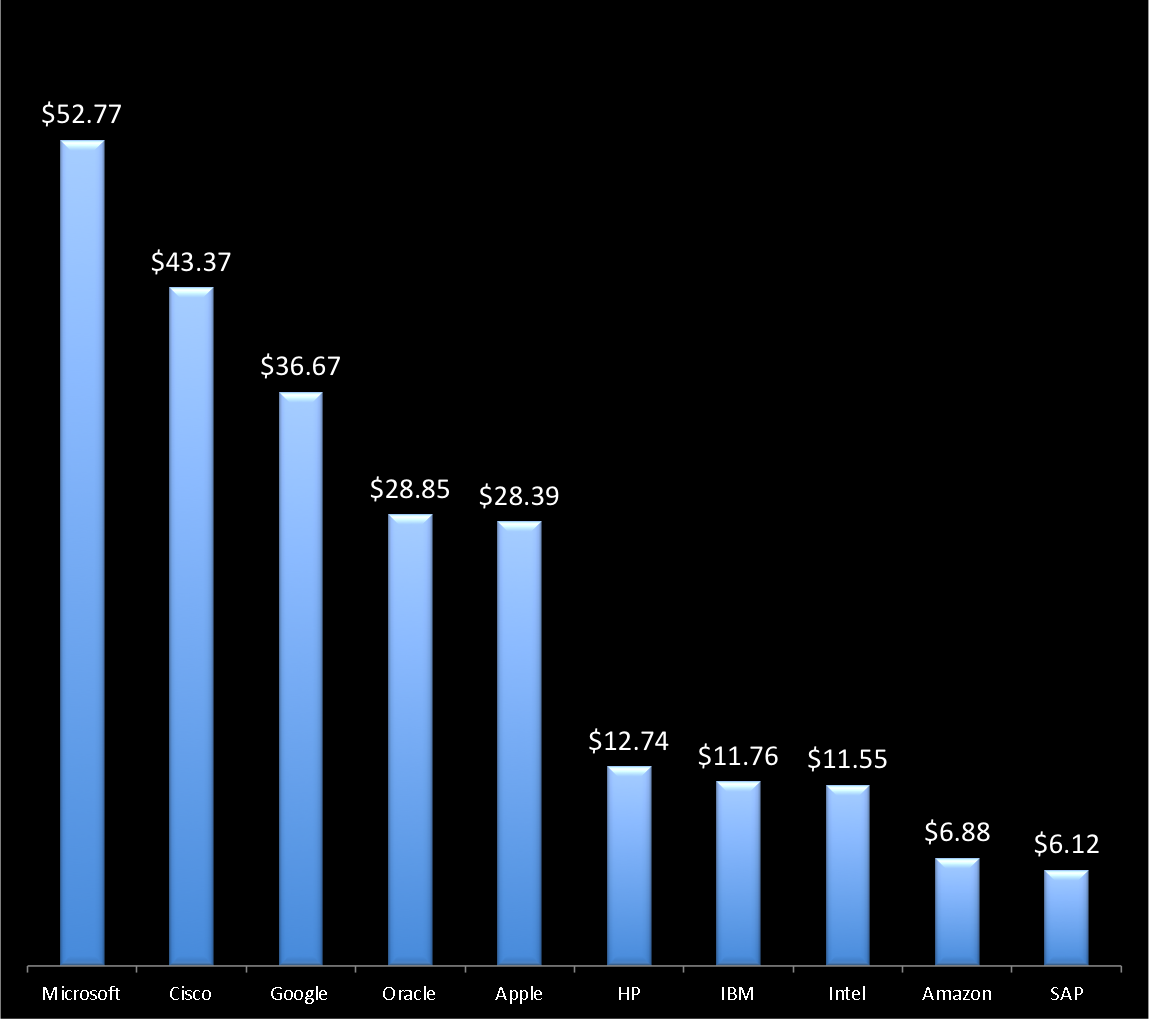
This is a great time to be a startup in the broader software sector.  The image below represents some of the largest public tech companies and the dollars figures shown is their respective cash on hand.  This cash will be primarily used to acquire private technology startups.  In total, these 10 public tech companies have $240 BILLION in cash!  Go get the money!

List of Active Seed Stage Investors

Here is a list of active investors in NYC (New York) based seed stage startups.  If you are looking for active Series A investors, see this post.

The definition of active means that the investor has made at least three new seed stage investments in a NYC startup in the last 9 months.  Some of the firms are new, so they haven’t made three investments yet but are planning on making investments.  Seed stage investment means that these investors participate in deals that are typically less that $2M in size.

New York based seed investors:

  • 500 Startups
  • Abdela, Angelo
  • Accel Partners
  • Advancit Capital
  • ARC Angels Fund
  • Betaworks
  • Black Ocean
  • BoldStart Ventures
  • Bowery Capital
  • Box Group
  • Brand Foundry
  • Brooklyn Bridge Ventures
  • Canaan Partners
  • Chart Venture Partners
  • Chertok, Doug
  • Coriolis Ventures (incubator)
  • Contour Venture Partners
  • Crossbar Capital (Charlie Federman)
  • Dace Ventures
  • Gotham Ventures
  • DreamIT Ventures (accelerator)
  • Dyson, Esther
  • ENIAC Ventures
  • ER Accelerator
  • Eskapa, Daniel
  • ff Venture Capital
  • Flybridge
  • First Round Capital
  • FirstMark Capital
  • Fogel, Avi
  • Founder Collective
  • Genacast Ventures
  • General Catalyst
  • Gilbert, Parker
  • Goldberg, Alexander (angel – Canary Ventures)
  • Golden Seeds (angel group)
  • Great Oaks Venture Capital
  • Greycroft Ventures
  • HBS Angels NY Chapter (Harvard Business School)
  • High Line Venture Partners
  • High Peak Venture Partners
  • IA Ventures
  • KayWeb Angels (equity in exchange for web development)
  • Lerer Ventures
  • LDV Capital
  • Marrus, David
  • MESA+
  • Metamorphic Ventures
  • Milestone Ventures
  • Neu Venture Capital (Jerry Neumann)
  • New York Angels (angel group)
  • New York Life Science Angels (angel group)
  • NextView Ventures
  • NYC Investment Fund
  • NYC Seed
  • NYU Innovation Venture Fund
  • Polaris Ventures
  • Quotidian Ventures
  • Red Swan Ventures
  • Richenstein, Larry
  • Rose Tech Ventures (David S. Rose)
  • RRE Ventures
  • Schneider, Mark
  • Softbank Capital
  • Spark Capital (Mo Koyfman based in NYC, firm based in Boston)
  • Techstars (accelerator)
  • Tevel Angels
  • Thrive Capital
  • Trisiras Group (Kal Vepuri)
  • Union Square Ventures
  • Upstage Ventures (Mark Wachen)
  • Urgent Ventures (Jeff Stewart)
  • Vaizra Investments (NYC/Israel)
  • Vaux les Ventures (Miles Spencer)
  • von Simson, Ernie
  • Whelan, Jon
  • Women Innovate Mobile (accelerator)
  • YavonditteMichael
  • Zelkova Ventures

Other investors active in New York seed deals (with location):

  • Battery Ventures (Boston)
  • Floodgate (Bay Area)
  • Forerunner Ventures (Los Angeles)
  • Javelin Venture Partners (Bay Area)
  • Khosla Ventures (Bay Area)
  • Launch Capital (Dave Shen, SF/Boston/New Haven)
  • Lowercase Capital (KA)
  • MentorTech Ventures (Philly)
  • New Enterprise Associates aka NEA (D.C. and Bay Area)
  • Resolute.vc (Boston)
  • SoftTech VC/Jeff Clavier (Bay Area)
  • SV Angel/Ron Conway (Bay Area)
  • True Ventures (Bay Area)

Zynga IPO S-1 Filing

This blog post was also published on Betabeat.

Zynga, the biggest casual gaming company in the nation and the maker of popular games titles such as Farmville, CityVille and Mafia Wars, filed for its IPO today.

To summarize quickly,  Zynga is performing extremely well. They were profitable in 2010 and will continue to be profitable in 2011 (based on 2011 Q1 figures). They are looking to raise $1B through the IPO and have $996.7 in cash on the books.

One of the highlights is that top line revenue is growing quickly, from $19.4M in ’08 to $121.5M in ’09, roughly 600% growth. It jumped another 500% to $597.5M in ’10 and their 2011 revenue run rate is $941.7, roughly 150% growth. Although their run rate is $941.7 for 2011, revenue expectations are closer to $1.5B, which would be 250% growth from 2010.

Zynga has raised over $500M from New York City investors such as Union Square Ventures, who own 5.5%. Based on this IPO, it would be safe to assume that Zynga’s valuation would allow USV to make back their entire fund $125M 2004 vintage fund.

Other investors include Foundry (6.1%), KPCB (11%) , IVP (6.1%), DST (5.8%), Avalon (6.1%), Andreessen Horowitz, Softbank, Google, Tiger Global, Reid Hoffman. The CEO of Zynga, Mark Pincus owns 16%.

While the company is performing very well, there are some significant risks to consider. The main issue is that Zynga continue to be very dependent on Facebook for distribution and monitization. Can Zynga find alternative avenues to lessen the dependency on Facebook?

The other challenge is that casual gaming in still a hits-driven business. Can they continue to produce great titles to retain existing players and entice new users to their games? Another challenge is that casual gaming has a very low barrier to entry. There are a lot of competitors who are developing good casual games: Angry Birds (Rovio Mobile), Crowdstar, Pocket Gems, Papaya Mobile, Disney (Playdom – $763M acquisition), EA (Playfish – $400M acquisition, PopCap, Firemint, Chillingo), DeNA (Ngmoco – $400M acquisition).

The evolution of gaming is mobile, which is not Zynga’s core strength. Zynga needs to become dominate in the mobile gaming market and develop on platforms such as iOS, Android and Windows Phone 7. While mobile games lessen the dependency on Facebook, there are still gate keepers in the mobile space including Apple, Google, Zong and Boku. Lastly Zynga is only four years old, which is still relatively young to be going IPO. If you look at the history of casual gaming, dominant players have come and gone, just look at the ups and downs of Atari, Sega and Capcom to name a few. The point being that remaining a dominant player in the casual gaming world is challenging and maintaining this level of growth, even tougher.

To summarize, Zynga is legitimate company that diminishes the argument of those who proclaim a tech bubble. The company faces many challenges but what is certain is that gaming is a huge market and Zynga has the opportunity to remain dominant.

Data in this story is taken from Zynga’s S-1 filing and acquisition numbers on Crunchbase. This post reflects Shai Goldman’s personal views and are not the views of his employer.

Hiring in NYC

Working in the NYC startup scene is really exciting right now.  There is so much energy and enthusiasm in the tech community.  There are many VC firms setting up shop, new incubators, growing list of co-working facilities and increasing amount of service providers, all of which are there to support this exploding (in a good way) startup environment.

Silicon Valley Bank has had an office in New York City for 10 years and we are expanding quickly!

I’m looking for a talented person to join our efforts.  Do you know someone who fits this criteria?

Requirements:

  • Passionate about technology, startups and entrepreneurship
  • Passionate about providing excellent customer service (see – Delivering Happiness)
  • Ability to interact with Founders and CEOs
  • Ability to manage a large portfolio (hundreds) of technology companies
  • Experience in financial services is a big plus
  • Ability to develop strong relationships with referral sources such as incubators , lawyers, accountants
  • Attention to detail
  • Ability to work independently but also work as part of a team
  • Ability to do administrative tasks
The perks:
  • Competitive salary
  • Great benefits (insurance, 401K, stock purchase plan, 4 weeks of vacation) – more info
  • Flexible work schedule and location (home, office, coffee shops, co-working facilities, etc)
  • Working for a company that has a great culture. We work hard, are passionate about entrepreneurship and like to have fun
  • You get to work with awesome NYC startups!
  • The office has less than 20 employees, so it has a startup feel even though SVB has 1,400 employees
About Silicon Valley Bank:
  • Started in 1983
  • We serve three groups: technology companies, venture capital firms and premium wineries
  • Traded on NASDAQ, ticker symbol is SIVB
  • Company is performing well and expanding
  • Global commercial bank with offices in Israel, UK, India and China and 27 offices cross the US
  • Headquarters in Santa Clara, California
What is the role:
  • So you have gotten this far, which is great.  So what are you going to be doing?
  • Primary responsibility will be to manage a portfolio of NYC startups, a few hundred
  • You are the primary point of contact for NYC startups (self funded, angel funded, VC funded)
  • This includes fielding phone call, emails, in person meetings, etc
  • Need to educate startups on the products/services offering of SVB
  • Open accounts for startups
  • Provide awesome customer service, I’m talking about 5 star service
  • If you do your job well, the startups you work will refer their startup friends to you
  • Allocation of time for this role: 40%  opening new deposit accounts, 40% managing the portfolio, 20% networking
  • The two of us will be part of a team and will work closely together

Interested?

  • Don’t email me directly (unless you know me already)
  • You must receive a referral from someone I know.  Leverage LinkedIn, Facebook, Twitter to get an introduction.  This should be pretty easy, I have a lot of contacts, someone you know probably knows me
  • Resume AND cover letter are required.  I received several emails with no cover letter, you need to provide one to be considered for the position.
  • If you are looking for a VC type position, this is not it (I received several inquiries, who assume this is a role to get on a path of a VC career)

Measuring Business Relationships

How do you measure the value of your business relationships?  I hear a lot of people in the business world say “yeah, I know that guy/gal”, I’m sure you say the same thing or have heard others say this.  I always wonder what it means to “know” someone from a business perspective, so I created a range of 0 to 5 to measure the strength of a business relationship.  I find that a strength of a relationships is tightly correlated to the amount of time you spend together.
  • 0 – the person doesn’t know who you are or your emails land in their spam filter 🙂
  • 1 – the person will answer your emails within a one week period and/or will remember your name when you run into them at events
  • 2 – you grab coffee with this person a couple times of year
  • 3- you grab lunch with this person a couple times a year
  • 4 – you grab dinner with this person a couple times a year
  • 5- you are actually friends, meaning you spend time together on weekends, going to sporting events, golfing, vacations, etc
Most of the people who say “I know this person”, their relationship falls in the 1 or 2 category.  How strong are your business relationships?

The King’s Speech

This evening I was able to finally watch the movie called The King’s Speech.  The movie was well done and was both inspirational and motivational.  For those who haven’t watched the movie, the short summary is that the King had a speech impediment and he was able to overcome it by the end of the movie.

It reminded me of two points in my life.

One, was when I was seven years old and moved to the U.S. from Israel.  At the time, I was fluent in Hebrew and had limited knowledge of the English language.  My parents decided to move to the U.S. quite abrubtly and didn’t have time to prepare for the new country while in Israel.  I was half way through second grade when I moved and joined a Jewish day school and the primary language spoken was English.   My first few years in the U.S. were quite challenging as I was playing catch up the entire time and was lacking self-confidence due to the language deficiency.  I had kids in school who made fun of my language skills, which lowered my self-confidence even further.  In the movie, the key challenge for the King was the lack of self-confidence and it took a lot of coaching for the King to gain his confidence and he nails his speech at the end.  The positive takeaway is that with practice and support, you are able to increase your confidence.   Both the King’s Father and Brother mocked and ridiculed him, which obviously didn’t assist the King in improving his speaking skills.  Unfortunately, if you have a speech impediment or language difficulty, you might have people around you such as the King’s Father and Brother.   Despite the two of them, the King was able to accomplish his goal.

The other point in my life that the movie reminded me of, was my college days.  I attended both Foothill College and Santa Clara University, and every time I had to present in front of my class, it was so frightening.  I think the fear of public speaking was derived from the time in my life when I didn’t know English very well and experienced some challenges in picking up the language.  I recall times in college where several days leading up to a presentation, I would be so nervous and anxious.  Failure was always in the back of my mind and I didn’t want people to make fun of me, which really held me back.

A few years after graduating from college, I decided to do something about my fear of public speaking.  I’m not sure who told me about Toastmasters, but I started looking into the organization.   After researching the organization, I found a few chapters near my home and work.  The first few chapters I found were not a great fit for me, but I finally found one chapter in Mountain View that I decided to call home.   Several years of Toastmasters allowed me to practice my public speaking in a safe environment and increased my confidence.  Since then, I’ve had the chance to sit on panels and speak in small audiences, typically 50 people or so.   The size of the audiences that I’m speaking to seems to be increasing over time and have recently had the chance to speak in front of audiences of several hundred people.  I don’t consider myself to be a great speaker yet, but I’m on my way and I’m always trying to find opportunities to increase my self-confidence.

If you have a fear of public speaking for whatever reason, there are people and organizations such as Toastmasters who can assist.  You will be able to overcome your fears!  As they said in the movie, don’t be afraid of your own shadow.

2010 in review

The stats helper monkeys at WordPress.com mulled over how this blog did in 2010, and here’s a high level summary of its overall blog health:

Healthy blog!

The Blog-Health-o-Meter™ reads Wow.

Crunchy numbers

Featured image

A Boeing 747-400 passenger jet can hold 416 passengers. This blog was viewed about 3,800 times in 2010. That’s about 9 full 747s.

In 2010, there were 7 new posts, growing the total archive of this blog to 20 posts. There were 13 pictures uploaded, taking up a total of 1mb. That’s about a picture per month.

The busiest day of the year was November 11th with 334 views. The most popular post that day was Boom.Done.Moving to NYC.

Where did they come from?

The top referring sites in 2010 were twitter.com, linkedin.com, lmodules.com, plancast.com, and facebook.com.

Some visitors came searching, mostly for think different, ipad vs rock, ipad vs, best vcs, and kindle vs ipad.

Attractions in 2010

These are the posts and pages that got the most views in 2010.

1

Boom.Done.Moving to NYC November 2010
3 comments

2

Is the iPad a game changer? February 2010
2 comments

3

About November 2008

4

2009: A Great Year For Sequoia Capital December 2009
1 comment

5

Bubble? November 2010
1 comment

Bubble?

The blog post dejour for those in the startup community (including several VCs) is to discuss an upcoming bubble.  These folks who are mentioning the bubble are those in the software sector, which includes consumer, enterprise and infrastructure.  The cleantech, hardware, and life science sectors are not part of this conversation.

There have been two bubbles in past 10 years, both which I was a witness of.  I’m not going to go into great length describing the two bubbles as there have been plenty of articles written on the topic, but here is a quick summary.

2000-2001 : many VC backed companies did not have the proper financial basis to go IPO, research Pets.com and Webvan for details.  Essentially too much speculation.  This bubble was mainly driven by the valley, VCs, startups and I-bankers.  Rightly or wrongly, a lot of money was invested into enterprise/infrastructure for the potential Y2K bug.  This downturn was exacerbated by 9/11.  Over $100B was invested by VCs in 2000.  NASDAQ dropped from ~5,000 in March 2000 to ~1,500 in September 2001.

2007-2008:  a lot of VC backed companies were raising large Series A rounds of $6M, with not much to show in terms of customer/revenue traction.  Follow on rounds were being done at inflated valuations, $50M+. The stock market tanked, primarily driven by inflated residential real estate prices, which was enabled by loose underwriting guidelines and poorly collateralized investment vehicles.  The difference is that the 2007 market crash was not the fault of tech companies, as it was in 2000-2001.  $32B was invested by VCs in 2007 (compare that to $100B in 2000).  NASDAQ dropped from ~2,800 in October 2007 to ~1,300 in November 2008.

2011?: Folks are saying there will be crash, the problem is that they are not providing specific data points as to why they believe this is going to happen.  What I hear from VCs is “it feels like a bubble is going to happen”.  I also hear, “valuations are too high for Series A deals”.  In 2010, we are on pace for $22B to be invested by VCs (compare that to $32B in 2007 and $100B in 2000).

We are not in a bubble, here is why:

  • Stock market is already depressed, so it will not pop as it did in 2000/2001 and 2007/2008
  • Overall economy continues to be very poor (except for tech) and unemployment is very high (except for tech)
  • There is a lot less supply of VC money.  In 2000 and 2007, there was too much supply of VC dollars.  In 2007, there was roughly $35B invested and 2010 it will likely be $22B.  Many VC firms are going out of business and follow on funds are typically much smaller (ie DFJ $650M to $350M, Menlo $1.2B to $400M, and many more)
  • Angels/Micro-VCs/Super Angels in aggregate equal ~$600M, that is roughly the size of one VC fund
  • Series A/Seed rounds or initial rounds of financing are much smaller.  In 2007, there were ~$6M, now they are ~$1.5M
  • Valuation of Series A/Seed rounds are much lower, In 2007, they were $6M Pre on a $6M raise, so $12M Post.  Now they are $4M Pre on a $1.5M raise, so a $5.5M Post
  • There is a lot of money sitting on the sidelines by startup acquires such as: Apple, Google, Oracle, Amazon, Cisco, Microsoft, HP, etc.  This cash will continue to be used to acquire startup companies 2011 as these large public companies need revenue/product growth, which is what acquired startups provide.

A point of emphasis, some VCs are saying there is going to be Angel/MicroVC/Super Angel bubble.  As I mentioned previously, if you add all these dollars, it is likely to be $600M, which is less than one VC fund.  Lets do that math Floodgate ($75M), SV Angel ($20M), 500 Hats ($30M), OATV ($51M), Lowercase ($8.5M), K9 Ventures ($6M), SofttechVC ($12M), Felicis Ventures ($40M), Harrison Metal (?), Baseline (?),Y Combinator ($8.25M), TechStars ($2.5M), Founder Collective ($40M), IA Ventures ($25M), etc.  The majority of the firms I mentioned have funds, of which many were raised in the past 12 months, so they still have another 12 to 24 months of runway, as most funds are deployed within three years.  In addition to the $500M, lets add another $100M for individual angels, some of who are active on AngelList, so in total $500M + $100M = $600M in the seed/angel category.  The seed rounds also include traditional VCs (funds larger that $100M) such as Sequoia, CRV, Trinity, Redpoint, Polaris, True, Greylock, First Round, Union Square,  etc.   It is difficult to know how much money from these funds are allocated for seed rounds, but it total, I would guess it it close to an additional $500M.  In total we there is $1.1B available for seed rounds ($500M + $100M + $500M).  In the big scheme of things these seed rounds make up a very small part of total VC dollars invested, which will likely be $22B this year. 

There is certainly an argument to be made about the challenges of finding great engineering talent, but that will not result in a bubble occurring.  Yes, there are a lot of incubators that are popping up, if those fail, that will not create bubble, they would be collateral damage.

There are a lot of companies that received seed funding this year who will not be successful, but that is not a definition of a bubble.  These companies are raising much smaller rounds ($1M compared to $6M) and they are lot more capital efficient.  Only a small percentage of startups become successful, this is true now and was true 10, 20 and 30 years ago.  Yes, many of the seed funded startups will not raise a follow on round of financing.  Seed rounds are meant to allow the startup to make a go of their business and if they fail to execute, they will not get additional funding, the next round of funding is never promised in this business.  In addition, there is a great emphasis for startups to get to cash flow positive and that a revenue model must be proven.

In summary, 2011 will be a good year for startups who are raising seed rounds, there is sufficient cash available, so go get it!

Sites that provided some of the data I used for this post:

http://www.chubbybrain.com/blog/a-guide-to-super-angel-investors-who-are-they-what-do-they-invest-in/

https://www.pwcmoneytree.com

http://www.businessinsider.com/who-are-the-super-angels-a-comprehensive-guide-2010-10?slop=1

Boom.Done.Moving to NYC

New York, concrete jungle where dreams are made of
There’s nothin’ you can’t do
Now you’re in New York
These streets will make you feel brand new
Big lights will inspire you
Let’s hear it for New York, New York, New York

by Alicia Keys “Empire State of Mind”

Right now (and over the past 18 months) New York is a very exciting place to be if you are startup. The blog post by Fred Wilson provides some data which compares NYC activity vs the Bay Area.  The underlying data in the post was provided by a great site called ChubbyBrain (aka CB Insight).  The question a lot of people have is whether the level of startup activity is sustainable in NYC?  My answer (& others in NYC area) is that, it is, which is why I’m excited to be moving there.

In the past nine years, I’ve worked closely with Bay Area startups and VCs.  I’m moving to NYC to support the startup community and be part of expanding services infrastructure that is needed to have a fruitful tech community.  My role will be the same as it was in the Bay Area; find great pre-VC backed startups to work with, assist these startups with their fundraising activities, host events that bring the startup community together and support organizations that are valuable to the startup ecosystem.

Although I’ve moving to NYC, I will be flying back to the Bay Area frequently to maintain the relationships I’ve developed there and feel the pulse of the Bay Area startup environment.  Both NYC and the Bay Area are known for their amazing bridges, so I see myself strengthening the bridge between both communities.

Did you know that Silicon Valley Bank has had an office in NYC since 2001?  The focus has primarily been on established startups that are VC backed and we currently work with most of the VC backed startups in NYC.  Most of the Pre-VC backed startups are working with the traditional non-tech focused banks such as Chase and TD Bank, I will be changing that.

Mike Moritz of Sequoia Capital

It was a very neat afternoon today.  Silicon Valley Bank hosted a special luncheon with Mike Moritz of Sequoia Capital.  He spoke about his book the Return of the Little Kingdom.

You can find information about Moritz here and here.  Although you can simply define Moritz’s success by some of the companies he has invested in.  These company names are all that is needed to be said: Yahoo, PayPal, Google, YouTube, Pure Digital (FlipCam), Zappos.  Yes, this is a sic list of companies, Wow!  He is considered to be on of the top VCs in the history of the venture capital industry.

Below is recap of some of Moritz comments/thoughts that are paraphrased and also includes some of my thoughts as well.

One of the members in the audience asked about the deals that he regrets not investing in.  He named several, but the most recent and relevant company he “passed” on was Netflix.  Moritz regrets not investing in this company as they have revolutionized the way movies are distributed.  He indicated that he invested in a similar type company that addresses a different market, GameFly, the Netflix for video games.

Moritz compares Sony to Apple, meaning that at one point Sony was THE consumer electronics company in the world and they lost their position when their Founder/CEO Akio Morita stepped down.  Moritz indicated the biggest challenge for Apple is going to be the day when the Founder/CEO Steve Jobs steps down.  He also indicated that the person who eventually replace Jobs, can’t be effective if he/she ask themselves “what would have Steve done” when tough decisions need to be made.  The person who replaces Jobs will need to have their own persona and unique ideas about how to run Apple.

Mortiz highlights the fact that the market cap of Apple at one time was $1B and that it is now nearing a market cap of $250B ($217B as of April 6, 2010).  The company has had a historic turnaround, look at the increase in stock price over the last ~13 years, $3.24 on December 23, 1997 and $239.54 on April 6, 2010.

Moritz is amazed by the level of detail that Jobs focuses on.  When Moritz spent time with Jobs, when preparing to write his book, Jobs was involved in the very little details and continues to do so today even though they are a much larger company compared to their early days in the 1980’s.

Apple creates products that their employees would use.  They don’t create products based on user groups/feedback.  The geeks at Apple want to best devices and are the ones who know what the market needs.  After Jobs returned back to Apple, after being fired, Jobs took a look at all the products that Apple was working and decided that Apple needed to focus on creating a few great products, now a bunch of products that were similiar to their competitors.

Remember the Think Different ads by Apple?  Mortiz believes that the ad was geared towards Apple employees and not consumers.  He believes that Jobs used this as a “calling card” for his employees.

Moritz indicates that one of the reasons that Jobs is so successful is that he is able to see the future before it happens.  The point is that you don’t create products on what is currently happening, you need to project what the market will need in a few years.  He is a visionary, which is a word that is really overused.  Jobs is a real visionary.

Mortiz commented that not many people could have led a company on the brink of bankruptcy in the late 1990’s to leading a remarkable turnaround.  Moritz indicated that Jobs tough experiences allowed him to have the mindset to persevere; Moritz indicated that we need to remember that Jobs was kicked out of Apple, the company HE created.  This must have been an embarrassing situation to say the least, but provided a tough life lesson that was useful to Jobs.

One of the audience members asked a question about the evolution of the media sector and if Moritz has seen an influx of companies founded by ex-traditional media professionals.  Moritz essentially said that most traditional media professionals do not get technology and therefore have a challenge in creating new evolving companies in new media.  He did indicate that if you’re a programmer with the sensibilities of someone from the traditional media, the world is your oyster.  One of the earlier comments of Moritz is that three companies are revolutionizing or revolutionized traditional media: Apple, Netflix, YouTube (Google).

Moritz was kind enough to stay after his talk and Q&A and sign his book for the 80+ CEOs/Founders who attended the event.  I had my book signed as well and am looking forward to reading it.

Venturebeat wrote a blog post on this luncheon, read it here.  In addition, Drue Kataoka wrote a blog post, read it here.

For those who attended the luncheon, please comment on any other insightful Moritz comments that I likely have missed.